
The Karlsruhe High Technology Hub
KIT houses numerous infrastructures and research platforms. Although all of these can be and have been operated independently and very successfully, it became obvious to us that a common framework for as many infrastructures as possible would be extremely valuable. Following this line of thought we are presently setting up the Karlsruhe High Technology Hub (KarlTech) which will integrate a number of existing or soon to exist infrastructures. KarlTech will at the same time provide the means to strategically develop existing infrastructure and adding new infrastructures to the framework, and at the same time provides a common user interface mainly directed at scientists at KIT but also open to other academic institutions and companies. This user interface will not only be used to book machine hours and operating personnel but will also provide an interface to exchange results and meta-data based on our experience with ELNs, e.g., Chemotion, LabIMotion, Kadi4Mat as well as molecule archives thereby directly connecting to research projects and commercial enterprises.
Starting in 2026 KarlTech will integrate three infrastructures: the KNMFi, the KCOP and the HSS.
 The Karlsruhe Nano-Micro Facility (KNMFi) is a very well-established infrastructure founded at the beginning of the PoF II period in 2008. It integrates technologies for multiscale structuring (of which some will move to our new KCOP cleanroom facility), automated and data-driven materials research, as well as nano- and micro-characterization of materials and (nano-/micro)structures. As a distributed infrastructure, the research facilities are located in several KIT institutes. The user access is coordinated based on the programme topics of Helmholtz Information. Over the years, the scientific equipment was continuously and consistently purchased and updated, the scientific equipment available within KNMFi therefore represents a value of about €35 million. Major pieces include a TEM, FIB, NMR, x-ray diffractometers, and computed tomography equipment. A late addition to KNMFi was a dedicated thrust to develop, adapt, and install data management platforms (Kadi4mat and Chemotion/LablMotion), hence adding a little 'i' to KNMF.
The Karlsruhe Center of Optics and Photonics (KCOP) is foremost a new €40 million, cleanroom center housing a 2,000 m2 cleanroom and will be mainly serving Helmholtz Information, Helmholtz Energy and Helmholtz Matter. Its main focus lies on the development and application of structuring and production technologies for optical and photonic devices. It will enter operation in autumn 2026. The scientific equipment is valued at about €30 million of new and relocated machinery and will be operated by a dedicated team of about 30 full-time equivalents (FTE) technical personnel. This cleanroom facility will replace a number of smaller and older cleanrooms at KIT which are poorly suited for state-of-the-art scientific equipment and which are inefficient to organize and operate. Scientifically, the equipment in KCOP will be operated by scientists from a number of institutes, either on a permanent or a temporary basis. Temporary access will be organized via a centralized booking platform, also serving as a central data hub and cloud lab.
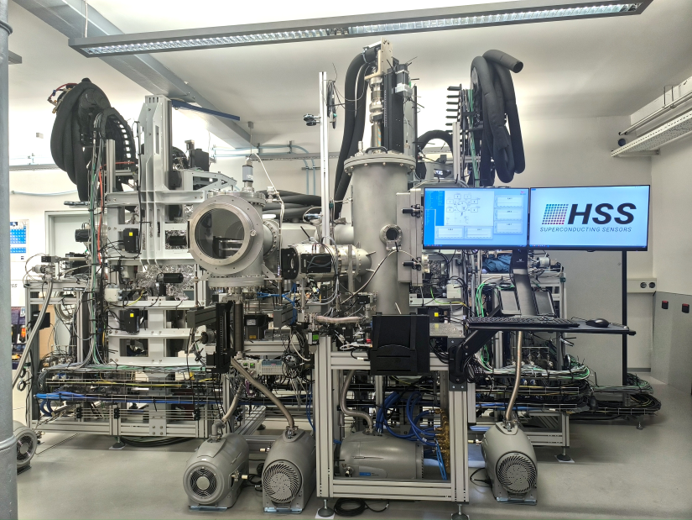 The Competence Center for High-Resolution Superconducting Sensors (HSS) is a unique infrastructure at KIT that enables the exploration and implementation of large detector systems based on superconducting quantum sensors. They provide ultra-high energy and time resolution and are sensitive to all types of radiation, including charged and neutral particles and photons with energies ranging from meV to MeV. Despite their importance and significance, superconducting quantum sensors are currently being built exclusively on a small scale by university research groups, which severely limits their potential areas of application. HSS will be located within the KCOP cleanroom, thereby addressing this shortfall and enabling the development, production, and characterization of next-generation instruments for tackling grand challenges in basic research, society, and industry serving a wide scientific community.
KarlTech will serve scientific efforts in Helmholtz Information, Helmholtz Energy and Helmholtz Matter and support a number of central research policy objectives like, e.g., the development of accelerated and increasingly autonomous materials systems development, the harnessing of quantum effects in materials for information, and the contribution to the development of resource-efficient information and communication technology. KarlTech will likewise contribute to a number of Helmholtz cross-programm cooperations like, e.g., Helmholtz QUANTUM, Helmholtz Biomedical Engineering, Information & Data Science, DataHub / DATALINK+, and Helmholtz Materials Research, Discovery, and Development as part of the Helmholtz Association's Materials Research Strategy.